
The Cheese Blog

Mozzarella need a summer break? Try ricotta
Ricotta, tomato & mint crostini
It’s easy to get into a rut with caprese salads in the summer. Tomatoes and basil are everywhere. Mozzarella is delicious. But after spotting more than one plate of the hallowed pairing at your second or third summery gathering, you realize that there might be such a thing as too many mozz and tomato dishes at one potluck.
Let’s mix it up. This easy celebration of ricotta and tomatoes is seasonal twist on caprese for when you want to give your mozz a rest.
Try a creamy local ricotta with garlic-rubbed crostini, tomatoes and mint.
It’s just as easy to make, a refreshing twist on a classic, and still using the season’s bounty so you’re not turning your back on summer produce.
Easy steps:
Buy your favorite local ricotta. The one I love that I see all over Northern California, in small and huge stores alike, is Bellwether’s basket ricotta, but you can get any you like. Calabro from Connecticut is also delicious.
Cut yourself some crostini and rub the top of the crostini with a clove of garlic. Toast the crostini in a toaster or in the oven. Drizzle with olive oil and sprinkle with salt and pepper.
Top the crostini with a thick slice of ricotta and lightly spread over the toast or cracker.
Slice different colored tomatoes to fit on the crostini, then place on top.
Sprinkle with chopped mint.
Drizzle with olive oil and sprinkle with salt and pepper one last time. Serve!

Kaymak

Kaymak: the Turkish cheese you need on your breakfast table
Originally from Turkey but found in many Baltic countries, parts of the Middle East and India, kaymak is the creamiest, sweetest cheese you will ever find. Technically more of a thick cream than a cheese, kaymak is traditionally made from raw buffalo milk that’s 60% butterfat (cow’s milk is around 8-15%). It tastes like mascarpone, or the thick, butterfat-laden cream that’s scraped from the top of a milk glass bottle, then saved and spread over toast later if you’re anything like me.
I first discovered this beauty when my then-boyfriend, now husband, took me to a local Turkish bakery for breakfast. In case you haven’t heard, Turks make a MEAN breakfast. We’re talking breads and pastries, jams, sausage, other meats, egg, cucumber and tomato slices, olives, and at least 2 different cheeses. On the day we ordered the mixed breakfast, it had all this, plus kaymak.
The middle of our breakfast platter was blessed a tiny dish topped with a scoop of milky white cheese, drizzled in honey. It tasted like amped up cream, like the clotted cream served with scones and jam in England, but sweeter. According to my husband, raw buffalo milk was easy enough to find in Turkey that his grandmother often made it at home.
How do you make kaymak?
The Turkish version made from raw buffalo milk isn’t exported here. If you find kaymak in the U.S, it’ll be mainly made with cow’s cream. Because I haven’t been to Turkey to try the buffalo version, I can’t speak to its deliciousness, but I can tell you the ones you get here are super good.
I’m not exactly certain how traditional kaymak is made because even though my friends who grew up eating it do their best to describe how their grandmother’s made the cheese, the recipes sound very complex, and maybe even a little like a family’s secret, but the gist of it follows. Raw buffalo milk is brought to a boil, then slowly cooled overnight. No stirring. It seems like sometimes ambient culturing might happen because the milk isn’t refridgerated. Then in the morning the important part happens. The layer of cream that floated to the top of the milk overnight is skimmed off, rolled, then chilled. If you talk to a dairy-loving inhabitant of the British Isles, this is very similar to how they’d describe how clotted cream is made, sans any culturing. If kaymak is made here or for export to the U.S., it’s almost always made by using cow’s milk cream.
Where to buy it:
At Turkish markets, and at many Middle Eastern and Eastern European markets. Look for something sold in a small tub that looks like this. Because it differs depending on what country it’s made in, the spelling may vary. I look for kaymak without any added sugar, as is traditional.
What to eat it with:
In Turkey kaymak is traditionally served with honey, rose petal jam, or whatever homemade preserves are served with breakfast. A Bosnian friend told me she grew up eating kaymak, or “kajmak” as it’s called in Bosnia, a little later in the day. She loves it spread over grilled meat or bread, or, added to pastries for extra creaminess.
My favorite way? With honey. I call it dessert for breakfast.

6 Great Gifts for Cheese Lovers

6 Cheese Gifts for your Cheese Lover
Finding shopping for your cheese nerd a little difficult, or just want a few fresh ideas? From maker to armchair cheese traveler, here are six gifts that will please any dairy lover in your life
A Gift Bundle from Saxelby Cheese: Saxelby Cheese is a legendary shop in NYC whose founder and owner convinced many cheesemongers that you don’t need to look to Europe to get amazing cheese. Founder Anne Saxelby was an American cheese visionary and advocate and her cheeses still are as special today as her. These bundles will warm any dairy lover’s heart. Here are a couple of my favorites.
Cheese Culture Coalition Donation: This organization could be one of the most important and fabulous cheese groups around. Its focus is to help make the cheese industry more inclusive to its BIPOC members, bring more people into the fold, and celebrate all that they do for cheese world. Donations help them provide fantastic scholarships to cheese conferences, and offer cheese classes to underserved communities. Also did I mention that its members are awesome? A donation in honor of your dairy lover would be a great gift.
Madame Fromage’s Adventures in Cheese Book, by Tenaya Darlington: This book is different because it suggests cheese plates (and trips) aimed especailly for cheese exploration. It mixes mozzarella with labneh, suggests “possible detours” for your favorite wedge alongside traditional pairings, and urges cheese lovers to get out there and travel. Pair this book with a cheese mentioned in the book and you have a delicious gift.
Pennyroyal Farm Cheese & Wine - If you get a chance to visit this creamery, do it. It’s a biodynamic winery-creamery all in one. But if you can’t make it to Mendocino, get this instead for a fantastic taste of California cheese and wine. The combos pair perfectly together and you can talk about the babydoll sheep that help keep the biodynamic vineyards tidy. So California.
18 Reasons Cooking School Gift Cards: Because it’s where I teach the most pairing and cheesemaking classes! But also because it’s a special non-profit whose tickets help fund a crazy amount of free nutrition and cooking education programs around the Bay Area. Plus, I’ve taken so many classes here I can attest that not only does this San Francisco institution have the coolest and most unique classes, the instructors are the best around. 2024 classes are being added to the calendar as I write.
A Cheesemaker Gift Certificate: This is for the cheese lovers in your life who can’t stop talking about the wine fridge they want to buy just to age cheese in. The Cheesemaker carries pretty much all you need for cheesemaking except milk. Which is good, because you don’t want to ship milk. They nearly always have everything in stock (trust me, it’s rare) to make cheese from mozzarella to gouda, including all the forms and do dads that fermentation and dairy nerds obsess about. This is where I send my cheesemaking students.

The Perfect Turkish Breakfast
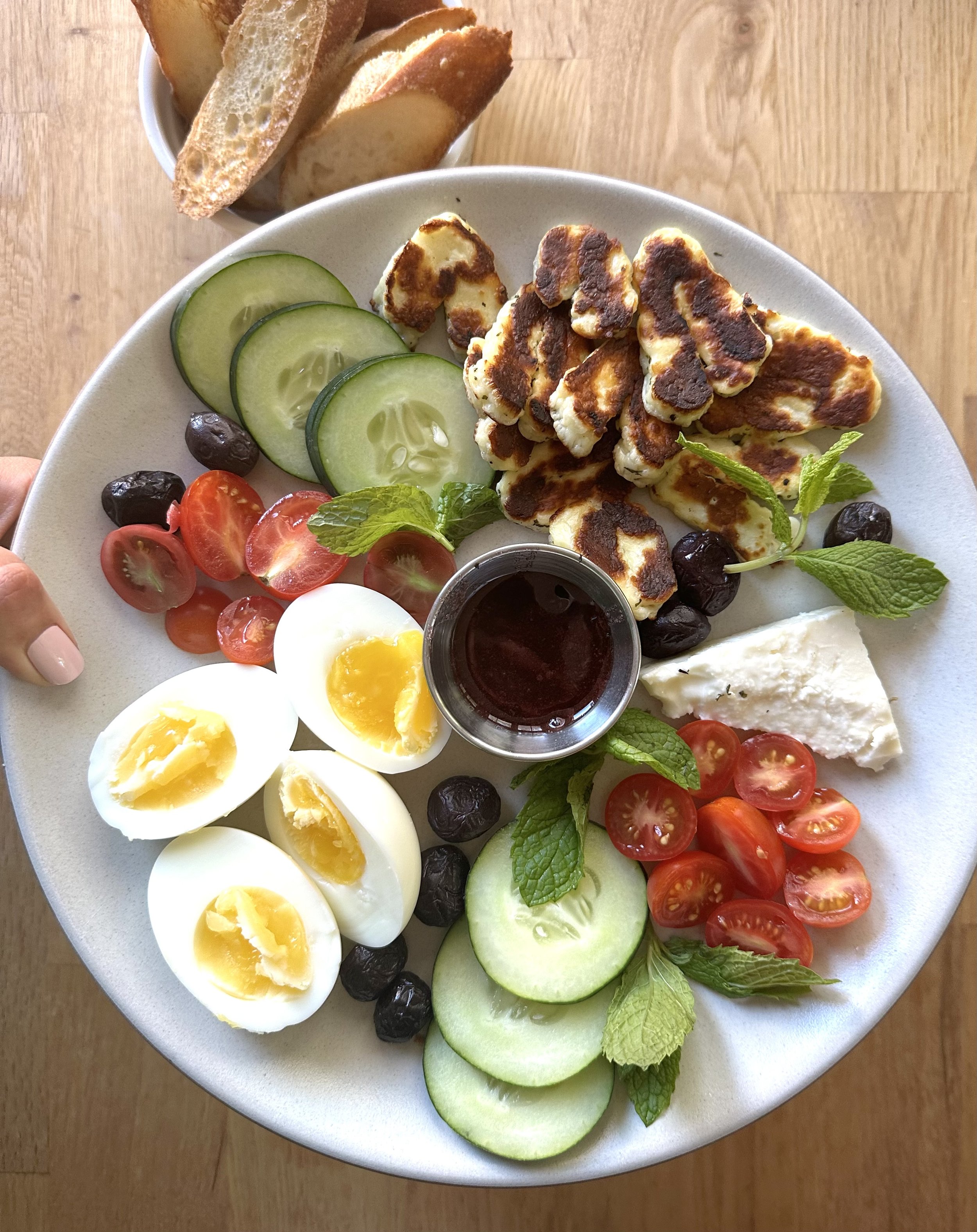
Turkish breakfast, husband and mom-in-law style.
Turkish breakfast recipe! My favorite breakfast of all time. Why? At least 2 different types of cheese. Olives. Jam. Great bread. Vegetables (cheese and veg for breakfast are both underrated in the U.S. in my opinion). And you toss it all on a few plates and share it with the entire family. There are many ways to make this breakfast, but this one includes the must-haves, plus a few extra flourishes, courtesy of my Turkish mother-in-law and husband. Make while California 🍅 are still looking fabulous.
1 serving
Ingredients:
1 egg
.7 ounces tomatoes per person (around 3 cherry tomatoes)
3 thin slices Persian cucumber
4-5 oil-cured olives
.75 ounces feta
1/4 baguette
1 teaspoon olive oil
3 slices halloumi, ⅛ inch thick, .5 ounces per slice
1 sprig mint
1 pat butter
Directions:
Place your eggs in a small saucepan and bring to a boil. Once boiling, lower the heat to a simmer and cook for 6 more minutes. Remove the eggs from the heat, drain the water, and refill the pan with cold water. Set aside and let cool. Once cool, peel the eggs
Cut your tomatoes in half if they are cherry tomatoes. Arrange the tomatoes, cucumbers, olives, and feta on a plate.
Slice your baguette in long, slim, diagonal slices. Toast.
Bring a sautée pan to high heat but don’t let the pan smoke. Add the olive oil and swirl the pan. Lay the halloumi in the pan. Flip the halloumi once the bottom is golden brown, then form a similar crust on the top side of the cheese.
Add the cheese, mint spring, and butter pat to your plate. Serve immediately.

3 Summery Cali Wines on my Table Now

Summer wines for me are refreshing, light, as relaxed as a beach read, and good with barbecue and easy meals. (Unless you are serving and in that case I’ll take whatever you’re pouring yay and thank you.)
My reds are often chill-worthy, and rarely darker than a Syrah. My whites are generally frisky and unoaked. My rosés, well, all they have to do is show up.
Three wines in particular have charmed me this summer. One is made by a friend of mine whose wines I’ve mentioned here before, another caught my eye because I’m a sucker for Italian whites grown in California, and another because, who doesn’t need a moderately priced great Pinot Noir? Check them out below and let me know what you think.
2020 En Cavale Vermentino, North Coast - I picked this up at my alma matter, Vintage Berkeley Elmwood. Because I am easily hooked by Italian whites grown locally, and endlessly curious about California wines I haven’t seen before, I set this aside immediately. Vermentino is normally seen in Sardinia, Italy, where it ranges from citrusy and zippy to slightly rich and seductive. This one was like a Sardinian wine, but waaaaay amped up. Think meyer lemon, mandarin orange, membrillo, with hints of muscat. So fun, and heady it works with al pastor tacos as well as it does a simple, fresh, herbed pasta. All native yeast and no fermentation.
2021 Presqu’ile Pinot Noir, Santa Barbara County - Maybe you’re a Pinot fan that is not a fan of Pinot prices. I hear you, and I raise you this wine. Around $26, it’s a steal for this grape. With its light body and 13.5% alcohol, this one’s a little different from other Central Coast pinots, but it still packs in the dark fruit the region is known for. A bottle of this is as charming as a cherry pie on a picnic.
2020 Stereophonic Heart Container Sangiovese, Paso Robles - Full disclosure, one of my best friends and former co-workers made this. Next disclosure, I wouldn’t include it if I didn’t love it. This Sangiovese is beautiful, and dare I say, it’s bottle is damn cute. Super fragrant, floral, and light-bodied in an old-school Italian way, but with lower acidity and richer California fruit. Dark cherries, roasted strawberries, tangerine zest, with just enough meatiness to handle a barbecued burger or pecorino.
Enjoy the rest of your summer, my friends!

2 Summer Cheese & Wine Pairings I ❤️

Southern French whites & Etna rosé ❤️ cheese
Every summer I get stuck on a few wine that are amazing for cheese pairing that I can’t get out of my head. Last summer it was Lambrusco (though who am I kidding, I’ve got 2 bottles chilling in my fridge now). This summer, it’s southern French white wine & Etna rosato (rosé).
This summer’s pairings were inspired by the crazy amount of classes I taught in June for which I tasted through an insane amount of cheese and wine to make sure I had the perfect pairings for my clients. Because someone’s gotta do it. Two wine and cheese pairings stood out that charmed the socks off both me and my students.
Southern french whites & cheese
I poured Domaine Majas Côtes Catalanes Blanc in my class, but any white wine from southern France, like those from Côtes Catalanes, Rousillon, and Languedoc regions, fit the bill. These wines tend to be unoaked but not too lean (they’re often filtered later, so are a tad richer than many unoaked wines), are citrusy and fresh, and have a great acidity. Meaning- they’re amazing with cheese! They hold their own in pairings, yet never overpower the dairy.
My favorite cheese picks for southern French whites: creamy cheeses like Brillat Savarin or Summer’s Snow, soft goat cheeses like Bijou or Selles sur Cher, or, washed-rind softies like Red Hawk or Époisses.
It can be hard to find wines that pair with washed-rinds, so stinky cheese lovers, be sure to try this combo!
Etna Rosatos
Rosatos -Italian rosés!- from southern Italy are so good, and my favorite rosato region is Siciliy’s Mount Etna. Mount Etna rosés tend to be Nerello Mascalese/Nerello Cappuccio blends. I poured Murgo Winery rosato in my rosé & cheese pairing private class. Etnas are light, yet pack a punch. Imagine watermelon, strawberry, tangerine zest, and a bustling acidity that lingers and makes them easy to pair to even aged cheeses.
My favorite cheese picks for Mount Etna rosatos French wines: feta, marinated goat cheesses, mixed-milk cheeses like Andante’s Rondo, and aged goat and cheese milk cheeses like ricotta salatas or Garrotxa.
Want more insight about these pairings? This is just a sneak peak for my readers. Over the next couple weeks I’ll also chat about them more on IG.

Meet River Whey Creamery of Schertz, Texas

Planning a road trip this summer through the southwest? Plot River Whey Creamery from Schertz, Texas, a little town just 25 minutes from San Antonio, on your itinerary.
Launched by a California native whose parents were involved in Silicon Valley’s early tech industry, then moved out to Texas in the nineties, River Whey Creamery is a growing creamery that just made it to Whole Foods. Meaning, we might see them out in California in the future, fingers crossed. Owner Susan Riggs learned artisan cheesemaking at Cal Poly and Vermont, then honed her skills in England and Wales. You can taste this last bit.
Reminiscent of two of the British Isle’s best cheeses, my two favorite River Whey’s wheels are Whey Blue, and Keystone.
Whey Blue is a double-creme blue that tastes somehow like a classy mix between a Stilton and a Cambolooza. Evidenced by the number of people in my classes that say they don’t like blue, but love Cambolooza, and the die-hards who swear Stilton is the best cheese on earth, Whey Blue is the perfect meeting point for blue-newbies and afficianados alike. This cheese loves sweet things like rose petal confit, honey, or a heady sherry.
Keystone is a cousin to British favorites Wensleydale, Lancashire and Cheddar. Though I found it more lemony than those territorials, it has a sharpness to it that mature cheddar lovers would appreciate . It’s crumbly, citrusy, tastes like fresh buttermilk, and is ready at anytime to be paired with a spicy red wine blend or fancy pickle. So… it’s a perfect picnic cheese!